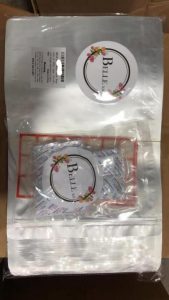

The client is a top-3 ranked Mylar bag seller on Amazon’s US marketplace, selling directly to end consumers through the platform. Mylar bags are a competitive, fast-moving category on Amazon — buyers compare closely on barrier performance, print quality, closure type, and price, and sellers who rank well typically do so by iterating quickly across sizes, finishes, and use-case-specific variants (coffee, herbs, snacks, pet treats, and general food storage) rather than offering a single generic product. Staying competitive in this category depends heavily on how quickly a seller can test and launch new SKUs in response to what’s actually selling.
The client’s previous packaging supplier operated with a traditional, inflexible production model built around large, standardized production runs — the kind of setup common among suppliers who serve bulk industrial or wholesale buyers rather than e-commerce sellers. This created two compounding problems for the client:
First, the supplier’s production workflow couldn’t accommodate the client’s existing packaging and fulfillment process, creating friction in day-to-day operations rather than fitting cleanly into it. Second, and more critically for an Amazon seller, the supplier had no meaningful capability to support new SKU development. Launching a new bag size, finish, or closure style required the same large minimum order quantities and long production lead times as a standard reorder — which meant the client couldn’t test new product ideas without committing significant capital and time upfront, with no guarantee the new SKU would actually perform once listed.
For a seller competing in a category where staying ahead often means responding quickly to shifting buyer preferences and seasonal demand, this lack of flexibility was a real constraint on growth — not just an inconvenience.
We restructured our approach specifically around what an e-commerce seller needs from a packaging partner, rather than applying a standard bulk-manufacturing model. This meant positioning ourselves as both the source manufacturer and a retail-ready packaging partner — capable of producing at wholesale scale when a SKU is proven, while also supporting the earlier, riskier stage of bringing a new product idea to market.
Concretely, this involved offering small-batch customization runs at meaningfully lower minimum order quantities than the client’s previous supplier required. This let the client test new SKUs — different sizes, finishes, or closure types — in-market with real Amazon buyers before committing to larger production volumes. Where a traditional bulk order might lock in months of inventory before knowing whether a product would sell, small-batch runs let the client validate demand first and scale production only once a SKU showed traction. We also streamlined turnaround time on these smaller runs, since for an Amazon seller, the value of testing a new SKU quickly is largely lost if sampling and production still take as long as a full-scale order.
This shift in approach translated directly into measurable account growth. The client’s packaging procurement grew from roughly $40,000 per quarter in 2024 to approximately $30,000 per month by 2026 — a substantial increase in order volume and order frequency that reflects both business growth and a deepening reliance on us as a primary packaging partner rather than one of several vendors.
Across this period, three new SKUs were successfully developed and brought to market with our support, moving from initial small-batch trial runs to full production once each product demonstrated demand. Of these three, two have shown early reorder growth — a meaningful signal in the Amazon marketplace, where reorders indicate a SKU has moved past the initial listing phase and is generating sustained buyer interest rather than a one-time sales spike.
Beyond the direct order volume, the engagement reflects a broader shift in how the client operates: rather than treating packaging as a fixed cost tied to existing products, the client has been able to treat new SKU development as a low-risk, ongoing part of their growth strategy — testing new product variants with confidence that production can scale quickly once demand is proven.